
National And Kapodistrian University Of Athens
Introduction: In acute respiratory distress syndrome (ARDS), two ventilatory variables strongly contributing to prediction of mortality are driving pressure and respiratory rate. The association between driving pressure and mortality depends on age being stronger in older than younger patients. There is a pathophysiological rationale that this might not be the case for respiratory rate. Given that the aging lung is adapted to high respiratory rate, one may infer that the aging lung may be resilient to the deleterious effects of high respiratory rate.
Objectives: Το examine whether a) the association between respiratory rate and mortality depends on age, and b) the relative contribution of driving pressure and respiratory rate to prediction of mortality in ARDS depends on age.
Methods: We performed a secondary analysis of individual patient-level data from seven ARDS Network and PETAL Network randomized controlled trials (namely, ARMA, ALVEOLI, FACTT, ALTA, EDEN, SAILS and ROSE). We assessed the association between respiratory rate and mortality across age using logistic regression analysis that included the interaction term between respiratory rate and age. To examine the relative importance of driving pressure and respiratory rate to prediction of mortality in ARDS across age, we performed dominance analysis.
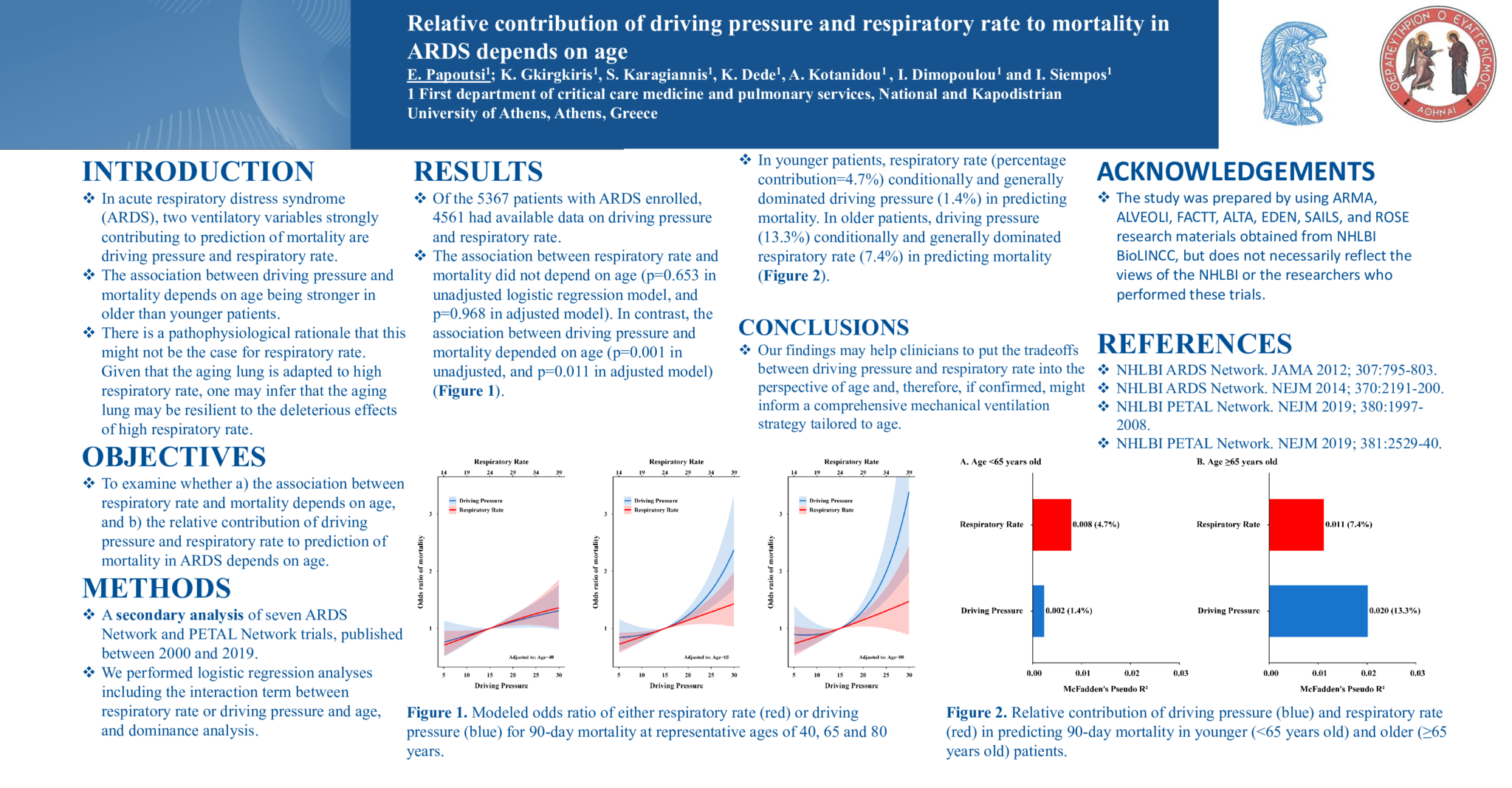
Results : Of the 5367 patients with ARDS enrolled, 4561 had available data on driving pressure and respiratory rate. The association between respiratory rate and mortality did not depend on age (p=0.653 in unadjusted logistic regression model, and p=0.968 in adjusted model). In contrast, the association between driving pressure and mortality depended on age (p=0.001 in unadjusted, and p=0.011 in adjusted model) (Figure 1). In younger patients, respiratory rate (percentage contribution=4.7%) conditionally and generally dominated driving pressure (1.4%) in predicting mortality. In older patients, driving pressure (13.3%) conditionally and generally dominated respiratory rate (7.4%) in predicting mortality (Figure 2).
Conclusions: Our findings may help clinicians to put the tradeoffs between driving pressure and respiratory rate into the perspective of age and, therefore, if confirmed, might inform a comprehensive mechanical ventilation strategy tailored to age.
- 2 προβολές
Abstract ID
ΑΑ49
Presentation day
Presentation monitor