
Γ.ν.α Ιπποκράτειο
INTRODUCTION :
Ovarian cancer is often diagnosed at advanced stages due to its non-specific clinical presentation. Although precise epidemiologic data are lacking, ovarian cancer presenting as perforation of a hollow viscus is considered exceptionally rare, with only isolated case reports described. Situs inversus totalis, a rare congenital condition characterized by the mirror-image transposition of organs, occurs in 1 in 8,000-25,000 live births, is itself an uncommon finding. The coexistence of these two rare conditions makes the present case unique, highlighting the diagnostic and technical challenges in such an unusual clinical scenario.
AIM : A rare case of ovarian cancer initially manifesting as hollow viscus perforation in a patient with situs inversus totalis
CASE PRESENTATION :
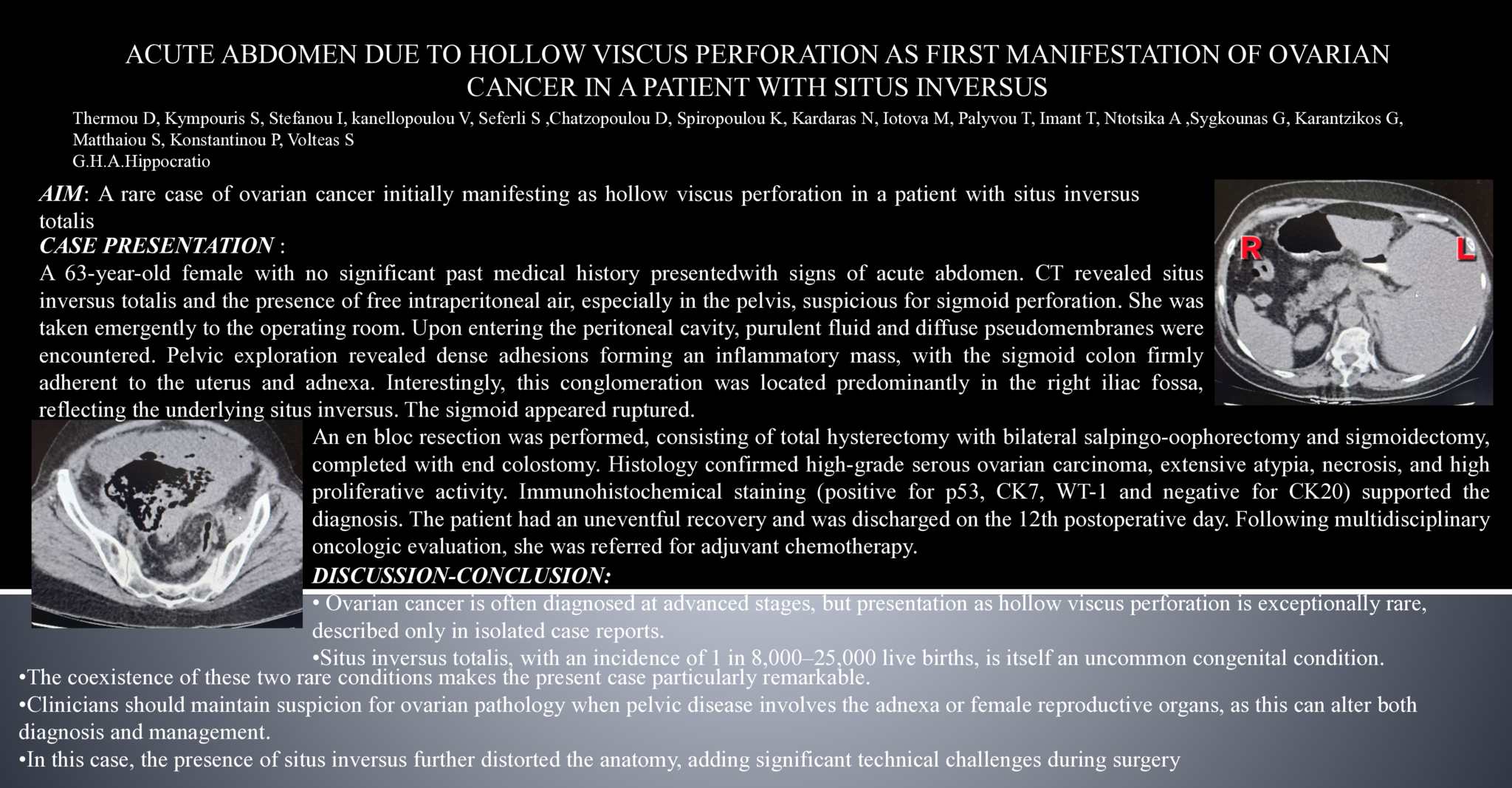
A 63-year-old female with no significant past medical history presented to the emergency department with signs of acute abdomen. CT revealed situs inversus totalis and the presence of free intraperitoneal air, especially in the pelvis, suspicious for sigmoid perforation. She was taken emergently to the operating room. Upon entering the peritoneal cavity, purulent fluid and diffuse pseudomembranes were encountered. Pelvic exploration revealed dense adhesions forming an inflammatory mass, with the sigmoid colon firmly adherent to the uterus and adnexa. Interestingly, this conglomeration was located predominantly in the right iliac fossa, reflecting the underlying situs inversus.The sigmoid appeared ruptured. An en bloc resection was performed, consisting of total hysterectomy with bilateral salpingo-oophorectomy and sigmoidectomy, completed with end colostomy. Histology confirmed high-grade serous ovarian carcinoma, extensive atypia, necrosis, and high proliferative activity. Immunohistochemical staining (positive for p53, CK7, WT-1 and negative for CK20) supported the diagnosis. The patient had an uneventful recovery and was discharged on the 12th postoperative day. Following multidisciplinary oncologic evaluation, she was referred for adjuvant chemotherapy.
COCLUSION- DISCUSSION:
Although ovarian carcinoma presenting as bowel perforation is exceptionally rare, clinicians should maintain suspicion whenever pelvic pathology involves the adnexa or female reproductive organs, as this may alter both the diagnosis and management strategy. In our case, surgical treatment was further complicated by the presence of situs inversus, which distorted anatomy and increased the technical challenges.
- 19 προβολές
Abstract ID
ΑΑ116