Πγνλ
Introduction
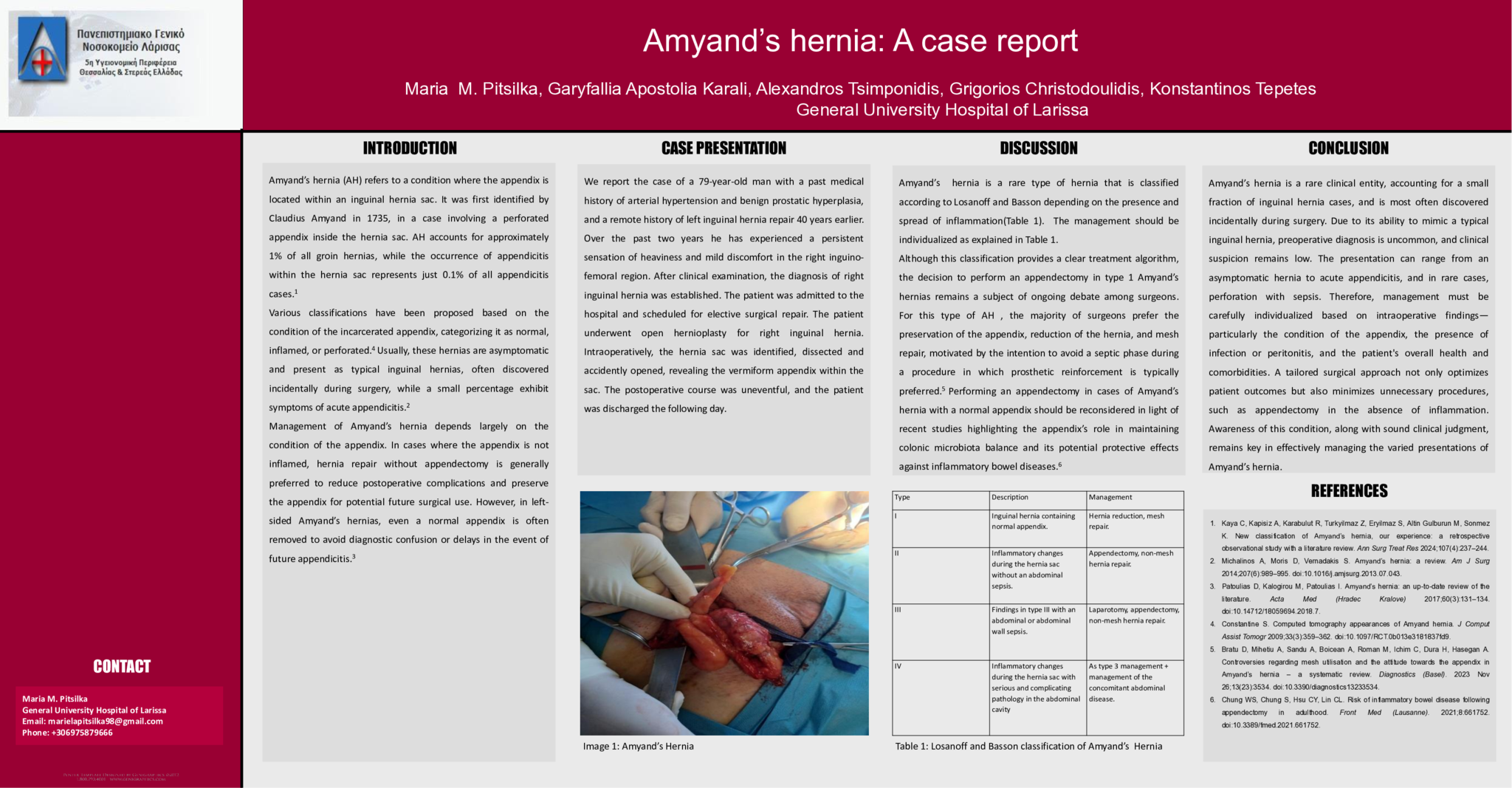
Amyand’s hernia (AH) refers to a condition where the appendix is located within an inguinal hernia sac. It was first identified by Claudius Amyand in 1735, in a case involving a perforated appendix inside the hernia sac. AH accounts for approximately 1% of all groin hernias, while the occurrence of appendicitis within the hernia sac represents just 0.1% of all appendicitis cases.1
Various classifications have been proposed based on the condition of the incarcerated appendix, categorizing it as normal, inflamed, or perforated.4 Usually, these hernias are asymptomatic and present as typical inguinal hernias, often discovered incidentally during surgery, while a small percentage exhibit symptoms of acute appendicitis.2
Management of Amyand’s hernia depends largely on the condition of the appendix. In cases where the appendix is not inflamed, hernia repair without appendectomy is generally preferred to reduce postoperative complications and preserve the appendix for potential future surgical use. However, in left-sided Amyand’s hernias, even a normal appendix is often removed to avoid diagnostic confusion or delays in the event of future appendicitis.3
Case Presentation
We report the case of a 79-year-old man with a past medical history of arterial hypertension and benign prostatic hyperplasia, and a remote history of left inguinal hernia repair 40 years earlier. Over the past two years he has experienced a persistent sensation of heaviness and mild discomfort in the right inguino-femoral region. After clinical examination, the diagnosis of right inguinal hernia was established. The patient was admitted to the hospital and scheduled for elective surgical repair. The patient underwent open hernioplasty for right inguinal hernia. Intraoperatively, the hernia sac was identified, dissected and accidently opened, revealing the vermiform appendix within the sac. The postoperative course was uneventful, and the patient was discharged the following day.
Discussion
Amyand’s hernia is a rare type of hernia that is classified according to Losanoff and Basson depending on the presence and spread of inflammation(Table 1). The management should be individualized as explained in Table 1.
Although this classification provides a clear treatment algorithm, the decision to perform an appendectomy in type 1 Amyand’s hernias remains a subject of ongoing debate among surgeons. For this type of AH , the majority of surgeons prefer the preservation of the appendix, reduction of the hernia, and mesh repair, motivated by the intention to avoid a septic phase during a procedure in which prosthetic reinforcement is typically preferred.5 Performing an appendectomy in cases of Amyand’s hernia with a normal appendix should be reconsidered in light of recent studies highlighting the appendix’s role in maintaining colonic microbiota balance and its potential protective effects against inflammatory bowel diseases.6
Conclusion
Amyand’s hernia is a rare clinical entity, accounting for a small fraction of inguinal hernia cases, and is most often discovered incidentally during surgery. Due to its ability to mimic a typical inguinal hernia, preoperative diagnosis is uncommon, and clinical suspicion remains low. The presentation can range from an asymptomatic hernia to acute appendicitis, and in rare cases, perforation with sepsis. Therefore, management must be carefully individualized based on intraoperative findings—particularly the condition of the appendix, the presence of infection or peritonitis, and the patient's overall health and comorbidities. A tailored surgical approach not only optimizes patient outcomes but also minimizes unnecessary procedures, such as appendectomy in the absence of inflammation. Awareness of this condition, along with sound clinical judgment, remains key in effectively managing the varied presentations of Amyand’s hernia.
- 22 προβολές
Abstract ID
ΑΑ473